Parish of the Assumption of the Blessed Virgin Mary in Kampinos
Beneficiary:
Parish of the Assumption of the Blessed Virgin Mary in Kampinos

ks. Bogusław Zalewski



A Parish That Remembers – Kampinos and Its Church at the Heart of History
In the very heart of the Kampinos Forest, where centuries-old pine trees rustle in the wind, stands a church that for generations has witnessed faith, hope, and the dramatic moments of Polish history. This is the Parish of the Assumption of the Blessed Virgin Mary in Kampinos – an extraordinary place where tradition intertwines with living memory.
Origins Reaching Back to the Middle Ages
The first mentions of Kampinos date back to 1377, when the settlement was known as Białe Miasto (“White Town”). This year is considered the symbolic beginning of the parish, which – according to historical accounts – was founded by Polish kings acting as its patrons. Soon afterward, new parishes were separated from the original one: Zawady and Pawłowice.
In the 20th century, after the establishment of the Górki parish in 1975, the Kampinos parish included only 10 villages – most of which had become nearly deserted.
A Jewel of Wooden Baroque Architecture
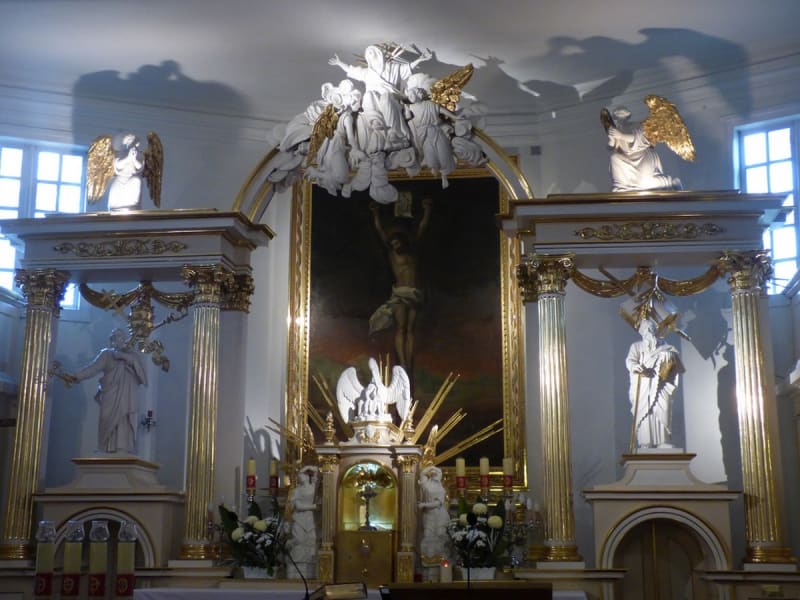
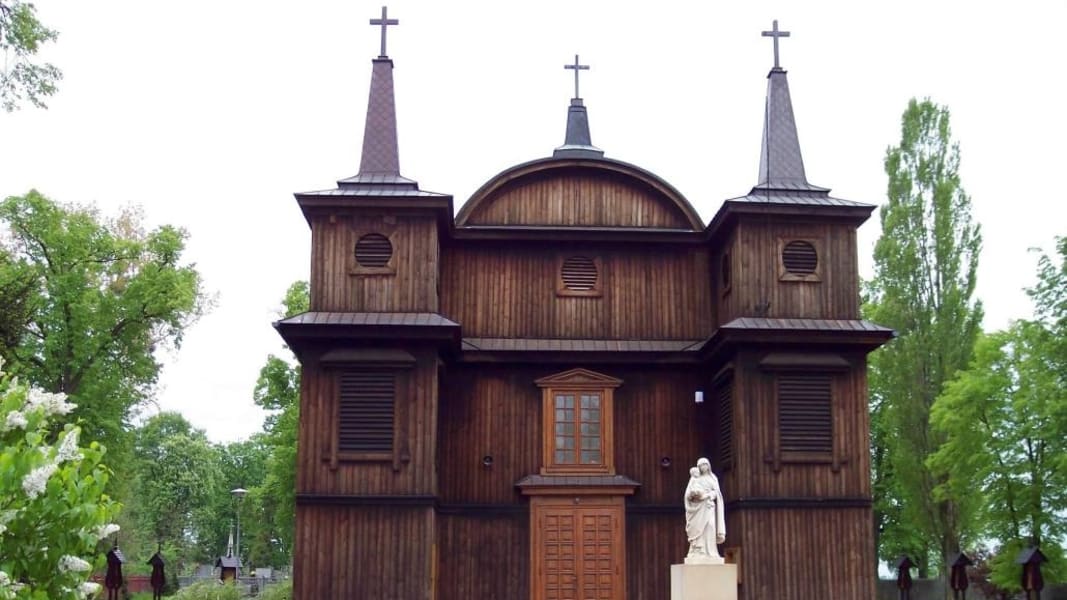
The present church, built between 1773 and 1782 from pine wood, is a beautiful example of Polish Baroque architecture. It was initiated by Fr. Forszet, and the construction was completed by Fr. J. Żegocki. The church was consecrated by Bishop Antoni Pobóg Malinowski in 1791. Its interior, which continues to impress visitors to this day, was designed by Fr. S. Smoleński.
The church underwent numerous renovations – in 1929 it was reinforced with masonry foundations, and in 1935 it was boarded and covered with a copper roof. The current bell tower dates back to 1988, although its predecessor stood here even before World War I.
The Forest and the Parish – Witnesses to History
Kampinos and its surroundings were the backdrop for many historical events. During the Kościuszko Uprising, on September 29, 1794, residents of the Sochaczew region gathered here to officially join the insurrection. Napoleon’s route toward Russia in 1812 passed through nearby Narty, and in 1863 participants of the January Uprising hid in the forests of Kampinos.
The tragic battle of April 14, 1863 ended with the deaths of 30 insurgents, including their commander Walery Remiszewski. Their memory was honored with a statue of the Virgin Mary with the Child Jesus (1865) and a grave at the parish cemetery.
World War II – The Spirit of Resistance
In September 1939, soldiers of the “Poznań” and “Pomorze” Armies sought shelter in the nearby forests after the Battle of the Bzura River. Between 1942 and 1944, Home Army units operated in the Kampinos Forest, forming the “Kampinos” Group. Its soldiers supported the Warsaw Uprising, fighting in the areas of Gdański Railway Station and Bielany. Sadly, during the retreat near Jaktorów, the partisans were defeated by overwhelming German forces.
And throughout all this time, the church in Kampinos endured – a silent witness to sacrifice, hope, and unceasing prayer.
Latest donations:
Anonymous donation
100 PLN - 19 days
100 PLN - 19 days
Anonymous donation
100 PLN - 2 months
100 PLN - 2 months
Anonymous donation
50 PLN - 2 months
50 PLN - 2 months
Paulina Włodarczyk-Dmoch
50 PLN - 2 months
50 PLN - 2 months
Words of support (2)
Anonymous donor
10 months
🙏
Anonymous donor
1 year
🫶❤️🙏
ACTIVE
Organizer:
Fundacja "Ofiaruję"
Latest donations:
Anonymous donation
100 PLN - 19 days
100 PLN - 19 days
Anonymous donation
100 PLN - 2 months
100 PLN - 2 months
Anonymous donation
50 PLN - 2 months
50 PLN - 2 months
Paulina Włodarczyk-Dmoch
50 PLN - 2 months
50 PLN - 2 months